




Editorial note: Throughout this article, references to Jmix technologies include both Jmix and its predecessor, CUBA Platform, reflecting the continuous evolution of the same platform, architectural ideas, technology stack, and community.
Some companies adopt a development framework for a single project.
Others build an entire product ecosystem on top of it.
INFOPRO belongs to the second group.
Over nearly four decades in banking technology, the company has evolved from Oracle Forms-based systems to a modern, modular banking platform serving more than 100 customers across 32 countries. Today, its solutions cover digital banking, lending, compliance, analytics, integrations, and AI-assisted services.
What makes this story particularly meaningful is not only its scale. It is also the company's ability to keep evolving without discarding everything and starting again every few years.
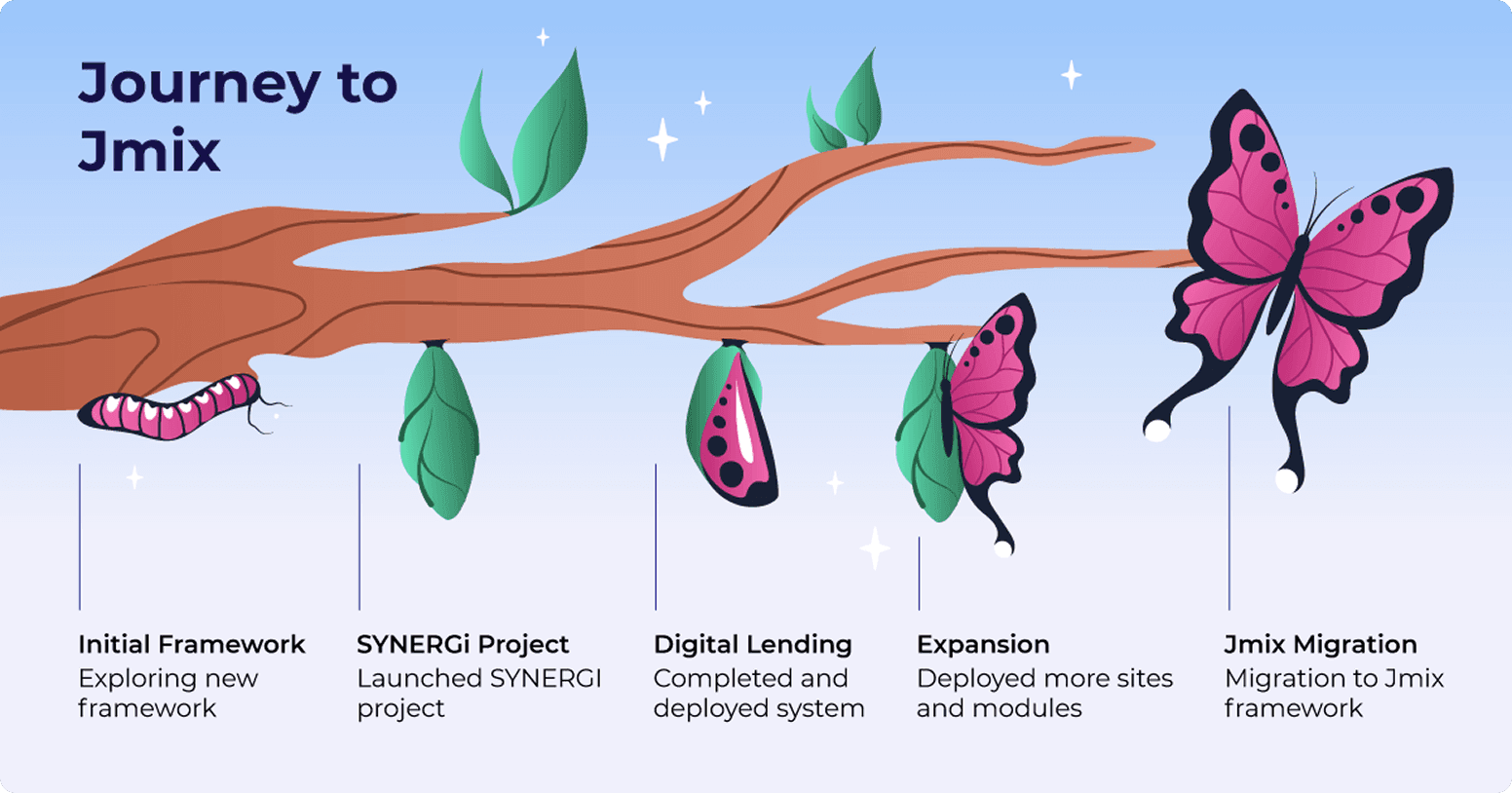
The journey began with Oracle Forms, continued with the technologies that would evolve into Jmix, and is now entering a new stage shaped by AI-assisted development.
As part of the Jmix 10-year anniversary series, Lee Chee Keong, Technical Director at INFOPRO, shares his experience of this journey.
From 4GL to the Web
I began working with application development tools such as Advanced Revelation and Informix. These tools allowed developers to create enterprise applications with relatively little coding.
It was the era of fourth-generation programming languages, or 4GL.
As enterprise technology evolved, client-server architecture became dominant, followed by the growth of web-based applications.
Oracle Forms became one of the leading tools for enterprise application development. It offered strong development productivity, but over time we began to encounter limitations. Modern user interface components were difficult to introduce, and integrations with external systems often required additional tools and effort.
Java offered technologies such as Swing and JSF, but these primarily addressed the user interface layer. We were looking for something that could also support the data and business layers within one coherent development environment.
Searching for a New Foundation
Our company needed to replace a large Oracle Forms codebase with a web-based solution that was not tied to the Oracle database.
We therefore began evaluating web development frameworks that could provide a modern and flexible foundation for enterprise applications.
That search led us to the platform that would later evolve into Jmix. At the time, it was known as CUBA Platform.
The platform had been recognized in several industry awards, and the trial license allowed us to prototype several small systems and evaluate the technology in practice. We subsequently used the platform successfully for several standalone web projects, gaining practical experience with its development approach.
The trial license allowed us to evaluate the platform in practice, and we later used it successfully for several standalone web projects..
Reconsidering the Development Approach
Later, I joined another company that was also using Oracle Forms. The team had already spent several years moving toward a Java-based client-server framework, but we decided to evaluate our development tools again. Based on my previous experience, I suggested that we consider Jmix technologies.
We also looked at other web frameworks. Many of them required separate skill sets for the frontend and backend, typically JavaScript for the user interface and Java for the server side.
For our team, this made rapid enterprise development more difficult. We needed a structured environment that would allow Java developers to work effectively across the application.
Haulmont supported us throughout the evaluation. The team arranged conversations with customers who were building similarly complex solutions, allowing us to learn from their experience. They also helped us understand how large enterprise applications could be structured and divided into manageable modules.
Proving the Approach
The opportunity to demonstrate the platform's capabilities on a larger scale came when one of our customers requested a major upgrade to an existing Oracle Forms solution.
Our development team consisted entirely of Java developers. Within five months, we built a working solution and demonstrated it live to the customer. That successful demonstration gave the company the confidence to select the platform as its primary application development environment.
This marked the beginning of what would become a solution factory for core banking systems, built on Jmix technologies. Following that first success, we began developing complete functional modules and delivering them to customers within six to twelve months. As the platform expanded, we added more modules and increased the number of development teams working concurrently.
The open-source foundation was especially important to us because it allowed the framework to be adapted to our specific requirements. We could also rely on existing add-ons instead of building every capability from scratch, while the flexibility of Spring made it easier to integrate our applications with a wide range of external systems.
Together, these capabilities helped us address areas that had traditionally required significant additional effort in Oracle Forms.
Within five months, we built a working solution and demonstrated it live to the customer.
Continuing the Journey with Jmix
As the platform evolved into Jmix, management asked us to reassess whether it remained the right choice for our long-term development.
The development teams strongly supported continuing with Jmix. They were already familiar with the platform's philosophy and development approach, while much of our existing knowledge and code could be reused.
Today, the migration to Jmix is almost complete, and our attention is already turning to the next stage of enterprise software development.
Agentic coding tools are significantly accelerating the journey from requirements and technical specifications to working code. Our next challenge is to use these tools effectively together with Jmix, enabling us to deliver new features and modules faster while ensuring that the resulting code remains maintainable and understandable for developers.
We hope to continue growing with Jmix and look forward to future developments that make enterprise application development even more productive and intuitive over the next ten years.

Thank You, CK
CK, thank you for sharing your story and for being part of the Jmix journey for so many years.
Your experience shows what long-term collaboration with a technology platform can look like: from the first prototypes and customer projects to a large modular banking solution developed by multiple teams.
We especially appreciate the trust your teams have placed in the platform, the experience you have shared with us, and your willingness to continue evolving your solutions together with Jmix.
It is exciting to see INFOPRO entering the next stage of this journey, exploring how Jmix and AI-assisted development can help teams deliver new capabilities while preserving the quality and maintainability required in enterprise banking software.
It is a privilege to have you as part of the Jmix community, and we look forward to continuing this journey together over the years ahead.