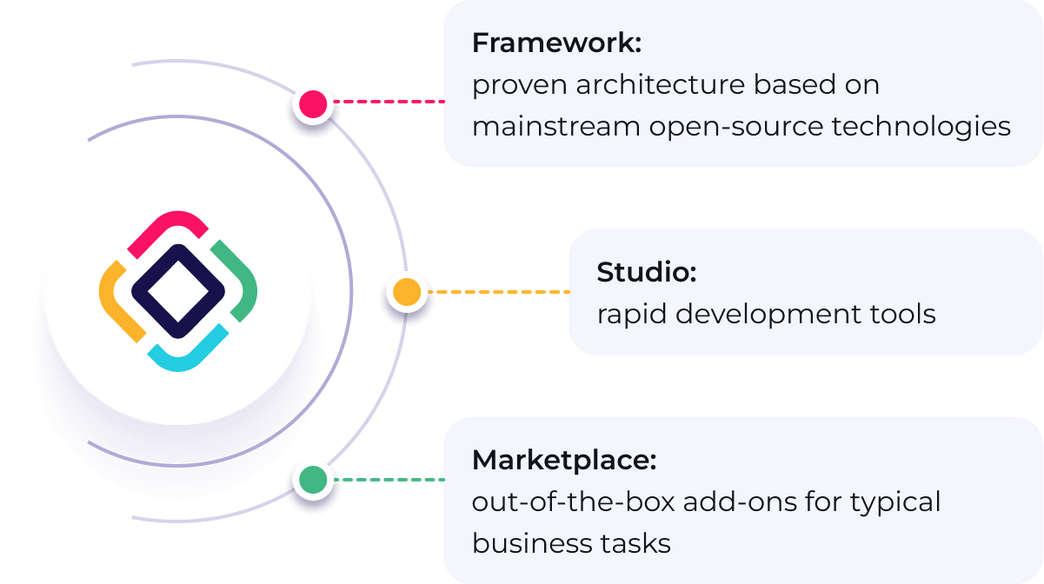
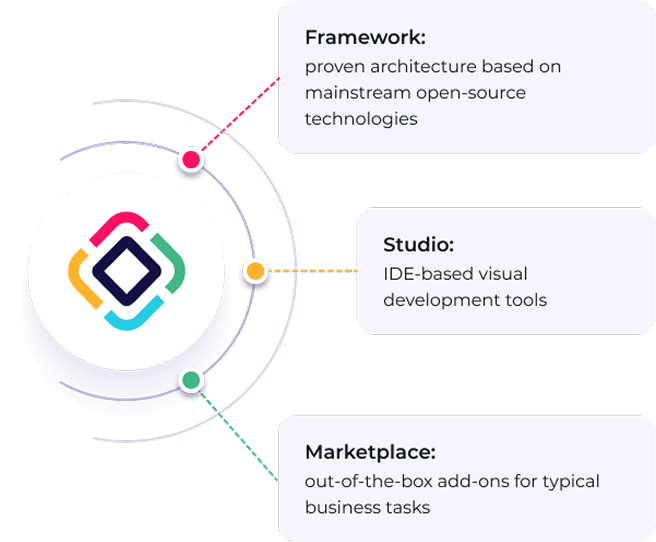
proven architecture based on
mainstream open-source technologies
Framework:

AI has changed how enterprise applications are built, but it hasn't changed what businesses expect from them. Applications still need to be secure, scalable, maintainable, easy to evolve over time, while preserving the ability to be changed "on the fly" without coding.
That's why choosing an alternative to OutSystems is no longer just about visual development or low-code features. It's about finding a platform that fits your architecture, your development team, and the way you plan to use AI.


Jmix is an open-source Java platform for enterprise software development with local and public AI models.
Unlike proprietary platforms, Jmix gives teams full control over application architecture, source code, deployment, and future evolution.
Applications remain yours: not tied to a vendor-specific runtime or licensing model.
By combining visual development tools, enterprise-grade Java technologies, and AI-assisted development, Jmix helps teams build and evolve enterprise applications without the limitations of proprietary low-code platforms.

































OutSystems and Jmix are application development platforms used to build and deploy enterprise software. OutSystems is a proprietary low-code platform focused on visual development and rapid application delivery.
Jmix is an open-source Java platform for enterprise software development with local and public AI models. It combines Java and Spring technologies, visual development tools, AI-assisted development, and full access to the application source code.
The right choice depends on your development approach. OutSystems is suitable for teams that prioritise visual low-code development and want to minimise hand-coding within a proprietary platform.
Jmix is better suited to Java teams that need greater customisation, architectural flexibility, AI-assisted development, and full control over the source code. Its visual tools, reusable components, and AI Assistant also help accelerate delivery.
Jmix is open source and based on standard Java and Spring technologies. Development teams retain access to the application source code and can modify, extend, deploy, and maintain their applications independently.
Jmix applications can run on-premises, in the cloud, or in hybrid environments. OutSystems is a proprietary platform, so applications remain more closely connected to its tools, runtime environment, ecosystem, and licensing model.
Jmix can be more economical, particularly for large or long-running projects. Its commercial plans are based primarily on developer subscriptions rather than the number of application users or runtime usage, making long-term costs easier to predict.
OutSystems uses a commercial subscription model, and costs may increase as the number of applications, users, or required platform resources grows.
Both platforms provide AI capabilities, but they follow different approaches. OutSystems delivers AI-assisted features within its proprietary low-code ecosystem.
Jmix brings AI assistance into standard Java development workflows. Its AI Assistant and support for coding agents help developers work with application code, generate functionality, navigate the framework, and automate routine tasks while retaining control over the architecture and source code.
Yes. Jmix applications can use public AI services as well as locally deployed models. This allows organisations to select models according to their security, infrastructure, performance, and data-processing requirements.
Local models can be used in restricted or on-premises environments, while public models can support cloud-based AI scenarios. In both cases, AI works within the application’s existing roles, access rules, and business logic.