


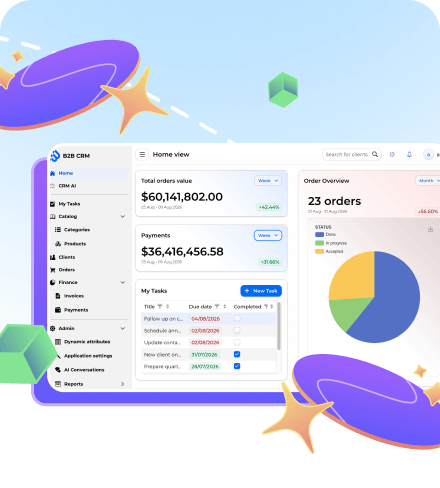


Editorial note: Throughout this story, references to Jmix technologies include both Jmix and its predecessor, the CUBA Platform – the framework on which Mladen first built his system.
In early 2019, while researching technologies for a new project, Mladen Bucan needed more than just a set of libraries. He was looking for a complete ecosystem: one that would let him focus on solving business problems rather than assembling an infrastructure from scratch.
After evaluating numerous solutions, the search ultimately led to the technologies that would become the foundation of his work for the next six years and counting.
Finding the Right Foundation
I first encountered Jmix technologies in early 2019 while researching the technology stack for a new project. I was building a custom call-center solution – a system that needed to handle complex workflows, structured data, and real business processes.
My requirements were demanding: I needed an application development ecosystem together with integrated business process management and workflow automation capabilities, not just a plain application framework with some BPM libraries bolted on.
I researched, tested, and trialled many different solutions. Eventually, my choice narrowed to Jmix technologies. The platform met most of my requirements:
- support for BPMN 2.0;
- an open-source foundation;
- a transparent licensing model;
- rapid application development capabilities;
- the Java ecosystem;
- built-in role-based access control;
- add-ons such as Maps;
- professional commercial support;
- and a proven track record with established customers.
It provided not only the individual technologies I needed, but also a coherent foundation on which I could build a reliable, maintainable system.
Returning to the Java Ecosystem
Choosing the platform also meant returning to Java after more than a decade of working with other technologies. The transition required effort, but the platform's structure and tooling made it manageable.
The project required several changes to the standard platform and its add-ons, and some of those changes were not straightforward. The Jmix team provided meaningful support throughout that process.
Whenever I needed guidance, the team came back with practical information. When the project encountered technical challenges, they helped us navigate them.
That support gave me the confidence to continue working with a technology stack that I was still learning, and to deliver a solution that met the real needs of the business.
Whenever I needed guidance, the Jmix team came back with practical answers and helped us navigate every challenge.
Becoming Part of the Community
As I gained experience with the platform, I began participating in the Jmix forums.
At first, I mainly asked questions when I needed help. Later, as my knowledge grew, I started answering questions from other developers who were facing similar challenges.
This became an effective way to deepen my understanding of the platform. It also allowed me to contribute something back to the community that had helped me get started.
Over time, the Jmix team began inviting me to share my opinions, ideas, and suggestions regarding platform features and direction. That kind of collaboration felt meaningful – it was a signal that community voices were genuinely heard.
Helping other people and sharing knowledge is rewarding in itself. Receiving the Jmix Ambassador recognition added to that sense of being part of something larger than a single project.
More recently, I published my first article about Jmix – and I am already working on further contributions.
Growing Together with the Platform
Over the years, Jmix has continued to evolve, bringing new capabilities, improvements, and a growing set of tools for developers. I have tried to follow that evolution and take advantage of what the platform offers.
The amount of knowledge available to developers has also grown significantly. Today, someone starting with Jmix has access to:
- comprehensive documentation;
- example applications;
- webinars and seminars;
- free training courses;
- GitHub repositories;
- community discussions;
- and AI-assisted development tools.
It is now easier than ever to begin exploring the platform and find help when questions arise.
Jmix has also consistently kept pace with the development of the Spring Boot and Vaadin ecosystems. That alignment has made it possible to benefit from advances in the broader Java ecosystem without having to abandon the platform or rebuild from scratch.
Looking back, my only regret is that I did not attend the Jmix seminars earlier. They would have shortened my learning curve considerably.
AI with Security and Governance in Mind
More recently, I felt what could be described as a disturbance in the Force, as developers around me began expressing concern that AI tools might make their expertise less relevant.
I do not share that anxiety.
What matters to me is how AI is introduced into real business applications. The Jmix team has approached this carefully, with attention to security, governance, and practical applicability. That approach aligns with how I think about the systems I build.
Building What Really Matters
Ultimately, Jmix allowed me to focus on the parts of the project that created real business value: the domain logic, the workflows, and the user experience – rather than on building and maintaining the underlying infrastructure.
Using the platform, I was able to deliver a custom call-center solution powered by complex BPMN workflows, rich data models, and role-based access control – without building all of that from the ground up.
The platform provides the application foundation, the workflow engine manages the processes, and I was able to concentrate on what actually made the system useful to the people working with it every day.
Jmix enabled me to focus on the important parts of the project without worrying about the underlying technical complexity.
The result is exactly the kind of system I was looking for when my research began in 2019: maintainable, adaptable, and built on a foundation that continues to grow.

Thank You, Mladen
Mladen, thank you for being such an active part of the Jmix community.
Your forum contributions, product feedback, articles, and willingness to help other developers have made the platform better and the community stronger. That kind of sustained, thoughtful engagement is exactly what makes an open ecosystem work.
It is a privilege to have you as part of the Jmix community, and we look forward to seeing what you build next.


