


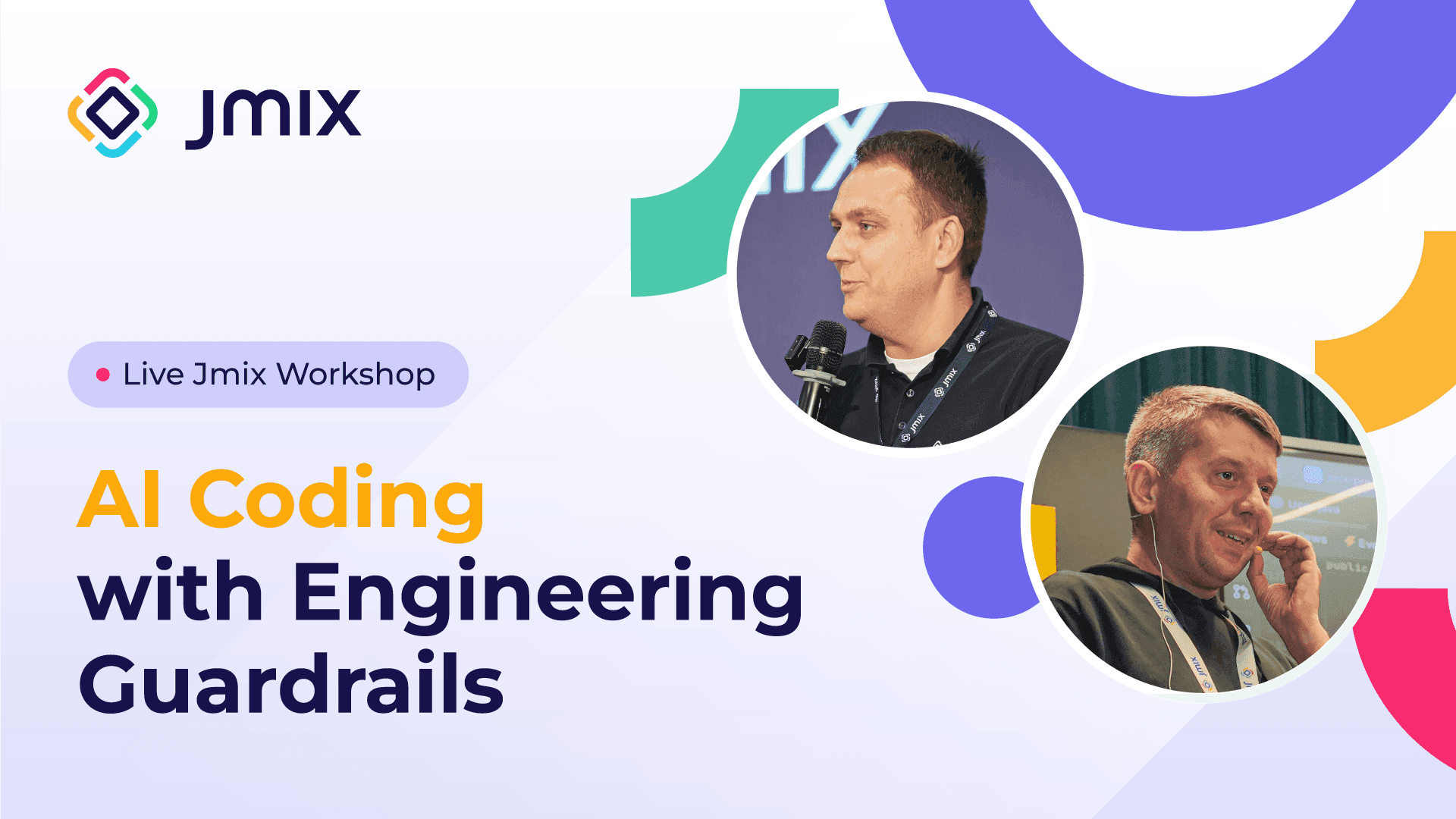

We ran the free live workshop "Jmix 3.0 in Action: AI Coding with Engineering Guardrails", where one industrial asset-management application grew live on air — from agent-assisted coding all the way to AI inside the running product and Enterprise runtime capabilities.
We recommend watching the workshop recording below to see how to give the agent a better context, keep engineering control, put AI inside a real Jmix application — and how Enterprise capabilities turn the result into an operational workflow.
Speakers: Dmitriy Vaschenko — Jmix trainer and consultant Alexey Burov — workshop host and moderator
What we did during this workshop
Showed the difference context makes — the same agent implemented a real business feature with and without Jmix-specific context: bare, it produced working but non-idiomatic code; with the official Jmix skill pack — project conventions, security rules, data-access patterns, and UI conventions, installed from Studio in under a minute — it had a much narrower and more useful path to the answer than a generic coding agent.
Caught and corrected what it got wrong — the agent reviewed its own work against the skill pack and found the deviations itself: business logic sitting in a view controller, a discarded save result. Jmix Studio inspections provided the same deterministic feedback to the agent as they do to the developer. The full feedback loop, with the developer still accountable for the result.
Moved AI inside the application — not just the IDE. Users ask questions about real asset data in natural language, answered through validated, read-only JPQL over the live data model. And with the Dynamic Data Model, the insight becomes a working enterprise workflow: a new entity with views and a menu item, added to the running application with zero restarts.


