



Low-code platforms were created to solve a simple business problem: how to build software faster and at a lower cost.
At first glance, the idea sounds straightforward. If developers write less code, teams should be able to deliver faster.
In practice, it is not always that simple. Reducing code does not automatically lead to better productivity, especially in enterprise systems where complexity grows over time.
This question becomes even more important in the age of AI.
To understand where low-code platforms work well and where they do not, it is useful to look at how these platforms operate, what problems they solve and how they compare to other approaches.
What are Low-Code Platforms
Low-code platforms are software development tools that reduce the amount of manual coding required to build applications.
What Problem Low-Code Platforms Are Solving
Even in highly digital organizations, the demand for software continues to grow.
For years, many companies have already moved away from manual and paper-based processes. Today, they face a different challenge: modernizing systems built 10–20 years ago and adapting them to current business needs with AI.
These systems are often deeply integrated, difficult to change and expensive to maintain.
At the same time, budgets remain limited. Teams are expected to deliver faster while keeping costs under control and maintaining predictable outcomes.
In this context, productivity becomes the key variable.
The cost of development depends on how quickly a team can deliver and how efficiently it can adapt to change. That is exactly where low-code platforms position themselves.
What Low-Code Platforms Actually Are
Low-code platforms were introduced to reduce the complexity and cost of traditional development.
At their core, they aim to minimize the amount of code developers need to write by replacing manual implementation with visual tools and generated logic.
Instead of building everything from scratch, teams rely on:
- Visual tools for designing data models, business processes and UI.
- Auto-generated code and database schemas.
- Built-in integrations with databases, cloud platforms and external services.
- Preconfigured scaling, security, logging and observability.
This approach allows teams to move faster at the early stages of development, especially when working with standard scenarios.



What Development Looks Like in Low-Code
In practice, building applications in a low-code platform often feels like assembling a system from predefined blocks.
Teams use visual editors, configuration panels and process designers to define how the system behaves, while the platform handles the underlying implementation.
At the beginning, the experience is usually fast and intuitive. In some cases, business users can even build simple workflows without deep technical knowledge.
However, enterprise systems rarely stay static.
Requirements evolve, integrations expand and edge cases accumulate. What initially looked like a straightforward configuration gradually turns into a more complex system that needs to be adapted over time.
This is where the difference between fast initial delivery and long-term maintainability becomes more visible.
Types of Low-Code Platforms
Low-code is implemented in several types of platforms.
Some solutions are built entirely around low-code, where coding is optional and often minimized. Others provide low-code capabilities inside packaged systems such as CRM, BPM or ECM platforms.
There are also development platforms where low-code is used selectively to improve productivity, while the core of the system remains code-driven.
Low-code platforms are often compared with no-code platforms. The main difference is that no-code tools are designed primarily for business users and rely almost entirely on visual configuration. Low-code platforms still target developers and allow custom code when business requirements exceed the capabilities of visual tools.
The key difference between low-code platforms and traditional development is the level of control over the code and architecture.
The key distinction is whether low-code replaces programming or complements it. This directly affects flexibility, scalability and control over the system.
Advantages and Challenges of Low-Code
Low-code platforms offer clear benefits, but they also introduce important trade-offs that become more visible as systems grow.
Advantages
Low-code platforms work particularly well in scenarios where speed and standardization are priorities:
- Faster development and shorter time to first release.
- Lower entry barrier for building internal tools and workflows.
- A unified platform across multiple departments such as sales, finance and operations.
These benefits make low-code platforms a practical option for prototyping and for automating predictable processes.
Low-code platforms are most useful for small to mid-scale systems, predictable workflows and rapid prototyping.
Challenges
As applications grow in complexity, the limitations of low-code platforms become more apparent.
Flexibility is often one of the first constraints teams encounter. Full control over system behavior is only possible when developers can work directly with the codebase. In many low-code platforms, applications remain tightly coupled to the platform runtime, limiting customization options and architectural freedom.
Scalability introduces another challenge. Platform-level limitations may not be visible during the early stages of development, but they can become significant as data volumes, integrations and business logic grow. Traditional software architectures typically offer more options for scaling through approaches such as microservices, cloud-native deployment and distributed services.
Cost can also become more complex than it initially appears. While low-code platforms may reduce development effort, the total cost of ownership often depends on licensing models, user counts, environments and platform-specific services. As systems expand, these costs can increase substantially.
Vendor lock-in is another common concern. Limited access to source code and platform internals can make organizations dependent on a single vendor for upgrades, support and platform evolution. This may reduce flexibility and increase long-term business risk.
There are also hidden costs related to project assumptions. Low-code initiatives are often planned as configuration-driven projects, but real-world enterprise requirements frequently introduce custom business logic, integrations and exceptions. As a result, complexity is often deferred rather than eliminated.
For these reasons, low-code platforms are most effective when requirements are relatively predictable and architectural flexibility is not a primary concern.
How AI Is Changing the Value Proposition of Low-Code
The rise of AI-assisted software development is changing how organizations evaluate low-code platforms.
Modern AI tools can generate code, assist with implementation, automate repetitive development tasks and accelerate software delivery without requiring a visual low-code environment. As a result, developers can achieve significant productivity gains while maintaining full control over application architecture, technology choices and source code.
This changes one of the traditional arguments for low-code adoption: reducing the amount of manual coding. When AI can automate large portions of development work, the competitive advantage of visual development tools becomes less pronounced.
As a result, many organizations are increasingly prioritizing flexibility, maintainability, source code ownership and long-term scalability alongside development speed.
This shift does not make low-code platforms obsolete. They remain a practical choice for rapid prototyping, workflow automation and many departmental applications. However, AI is changing the evaluation criteria. Organizations are now comparing low-code platforms not only with traditional development, but also with AI-assisted code-first platforms that combine developer productivity with full architectural control.
Alternatives to Pure Low-Code
An alternative approach focuses on improving developer productivity while keeping full control over the code.
In this model, visual tools are used where they provide clear value, but they do not replace the underlying architecture.
Jmix is an example of this approach. It is an open-source Java platform for enterprise software development with governed AI integration, combining a unified technology stack with a modular architecture.
This combination allows teams to move quickly without losing control over how the system evolves.
Typical use cases include back-office systems, customer portals, administrative interfaces and document workflows.


How Jmix Improves Development Productivity with AI
In enterprise development, a significant portion of effort is spent on repetitive tasks.
For example, even a simple change, such as adding a new attribute, often affects multiple layers of the system, including the database, backend logic, API and user interface.
Jmix reduces this overhead by connecting application layers through a unified data model and metadata-driven approach.
- Changes in the data model propagate across UI, data access and security.
- Standard functionality such as data handling, filtering and common actions is generated automatically.
- Visual tools support modeling and configuration while keeping the underlying code fully accessible.
- Developers can modify or extend any part of the system directly in code.
This approach makes it easier to adapt systems to changing requirements without rewriting large parts of the application.
How AI Is Changing Software Development
AI is rapidly transforming how software is built.
Modern tools can generate code, assist with implementation and automate routine development tasks. This significantly reduces the time required to build initial versions of systems.
At the same time, enterprise development introduces additional requirements.
Generated code needs to be maintainable. Systems must meet security standards. Architecture needs to remain consistent as the system grows.
Without a structured foundation, AI-generated solutions can become difficult to evolve and maintain.
This is why the role of the platform becomes critical.
How Agent-Based Development Works in Jmix
In Jmix, AI operates within a predefined architectural framework rather than replacing it.
This ensures that generated functionality aligns with system structure and constraints.
- AI works with high-level abstractions instead of raw code.
- Security, access control and auditing are integrated into the platform.
- Applications follow consistent architectural patterns.
- Systems remain scalable and maintainable as they evolve.
As a result, AI becomes a tool for accelerating development rather than a source of inconsistency.
Additional AI Capabilities in Jmix
Jmix also supports several practical AI use cases that can be integrated into enterprise systems.
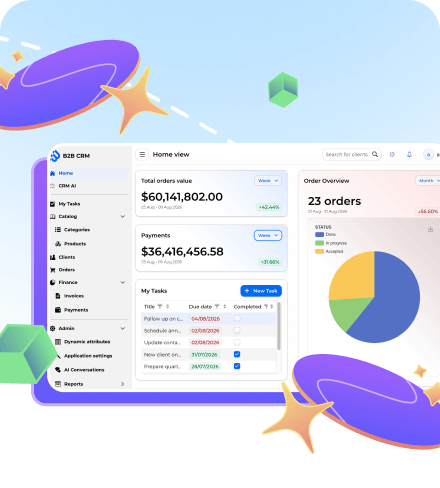
For example, the B2B CRM demo application built with Jmix shows how to develop production-ready business systems, including customers, orders, invoicing, finance and analytics. It reflects real ERP and CRM scenarios and demonstrates best practices in domain modeling, UI, security and business logic. The source code is available on GitHub.
Developers can use an AI assistant to better understand the platform and accelerate onboarding.
AI agents can automate routine operations, analyze structured and unstructured data and support decision-making processes.
The key factor is that these capabilities are implemented within a controlled and secure architecture.


When to Use Low-Code vs Code-First Platforms
Choosing the right approach depends on the type of system and its expected evolution.
Low-code platforms are a good fit for:
- Small or mid-scale systems.
- Predictable workflows.
- Fast prototyping and rapid delivery.
Code-first platforms with built-in productivity tools are more suitable when systems require long-term flexibility and scalability.
- Complex enterprise systems.
- Advanced integrations.
- Strict security requirements.
- Continuous evolution over time.
In enterprise environments, the choice between low-code and code-first platforms depends on scalability, flexibility and long-term maintainability.
In practice, different approaches serve different needs.
As AI continues to reshape development, the most effective strategy is not choosing one approach exclusively, but understanding how to balance speed, control and architectural integrity.


